
Construction Dust in Your Truck Isn't Just Dirt
You can wash a truck that's been on a job site. The outside comes clean, the box comes clean, and you drive away feeling like you dealt with it.
Then you get in the next morning, shut the door, and the low sun hits the windshield at the wrong angle. There's a haze hanging over the whole dash. You wipe it and your hand comes away grey.
That's not dirt in the way mud is dirt. Job-site dust behaves differently, and the way it behaves is exactly why a shop vac and a rag never actually finish the job.
Job-Site Dust Is Not House Dust
Three kinds show up in Fraser Valley work trucks, and none of them are harmless:
- Concrete and cement dust — alkaline. It doesn't sit there neutral. It reacts with moisture, and once it gets damp in your carpet it sets rather than rinses.
- Drywall dust — gypsum, microscopically fine, and it goes airborne every single time you drop into the seat. It's the one that never seems to end.
- Rock and gravel dust — the valley speciality. Pit roads, gravel yards, farm approaches, the shoulder of every back road out past Greendale. Silica-hard, and shaped like broken glass when you put it under magnification.
That last one is the one nobody accounts for. This valley runs on gravel — riverbed gravel out of the Vedder and Chilliwack River systems, pit roads up the mountain, farm approaches, and whatever the Highway 1 work is throwing into the air that month. If you work in the trades around Chilliwack you have rock dust in your truck whether or not you've been near a framed wall.
The word for all of it is abrasive. It isn't just making the truck look tired. It's sandpaper that lives in the carpet and gets walked into the fibres every time you climb in.
Where It Buries Itself in a Cab
Dust doesn't sit where you can see it. It migrates, settles, and packs. In a working truck it collects in the same handful of places every time:
- The base of the windshield and the defroster vents — a shelf that catches everything and blows it back at you
- The HVAC system itself, which is why the first cold morning in October smells like a job site
- The base of the carpet fibre, under the mats, where it's ground in rather than sitting loose
- Seat seams and bolster stitching, which is a perfect trap
- Under the seats and along the rails — dust plus wrappers plus whatever rolled under there in July
- The headliner, because heat carries fine dust up and hands put it back
- Door cards and window seals, so grit rides up and down the glass every time the window moves
- The wheel, shifter and switchgear — anything a work glove touches
Why Your Shop Vac Loses This Fight
Nobody's doing it wrong. The tools just aren't built for it.
A standard shop vac filter doesn't catch dust this fine, so a meaningful share of what you pull up gets exhausted straight back into the cab. You feel that — it's the burst of haze in the air after you vacuum.
The vacuum also only pulls from the top of the pile. Abrasive dust has already worked its way down to the base of the carpet backing, and suction alone won't lift it out of there.
Then there's the dry-rag problem. Wiping a dusty dash with a dry cloth drags grit across soft plastic. That fine scratch haze on the top of a work-truck dash is almost always cleaning damage, not wear.
And water makes concrete dust worse, not better — you're mixing a paste and pressing it into the weave.
You can keep job-site dust down with a vacuum. You can't get it out with one. That's an honest limit, not a sales line.
What It Costs You Over Three or Four Seasons
Abrasive dust is a slow bill:
- Carpet fibre grinds flat and goes permanently grey — that one doesn't come back
- Soft-touch plastics pick up a cloudy scratch haze from repeated dry wiping
- Window seals and regulators wear faster with grit riding the glass
- The cabin filter loads up, the blower works harder, and airflow drops
- The interior reads as "neglected" to anyone appraising it, which matters more than people think when you go to trade the truck in
- And you're sitting in a sealed box breathing it for nine hours a day
What We Do With a Dust-Packed Cab
We've been cleaning valley work rigs out of the shop at 44344 B Yale Rd since 2020, and this is a big share of what rolls through the door. Work truck detailing exists as its own thing here because trucks like yours aren't commuter cars with more mileage.
On an Interior Detail at $325 the dust work looks like this:
- Compressed air first — the dust gets driven out of vents, seams and stitching before anything wet touches it, because wet dust is a paste
- Extraction, not surface vacuuming — hot water pulled back out of the carpet, which lifts what's bedded into the base of the fibre
- Steam on the hard surfaces, which loosens film without a rag scrubbing grit across it
- Every vent, jamb and seam individually, since that's where the reservoirs are
- Interior glass last, once the airborne stuff has stopped moving
If the outside has been sitting under the same dust, the Complete Detail from $425 covers both and saves you $150 against booking the two separately. The full breakdown is on our pricing page.
The Add-Ons a Dusty Truck Usually Wants
- Seat extraction — pulling the seats to get at the packed dust along the rails and under the frames. Quoted on sight.
- Headliner cleaning — $100 flat. On a dusty truck the liner is grey and nobody notices until it's clean again.
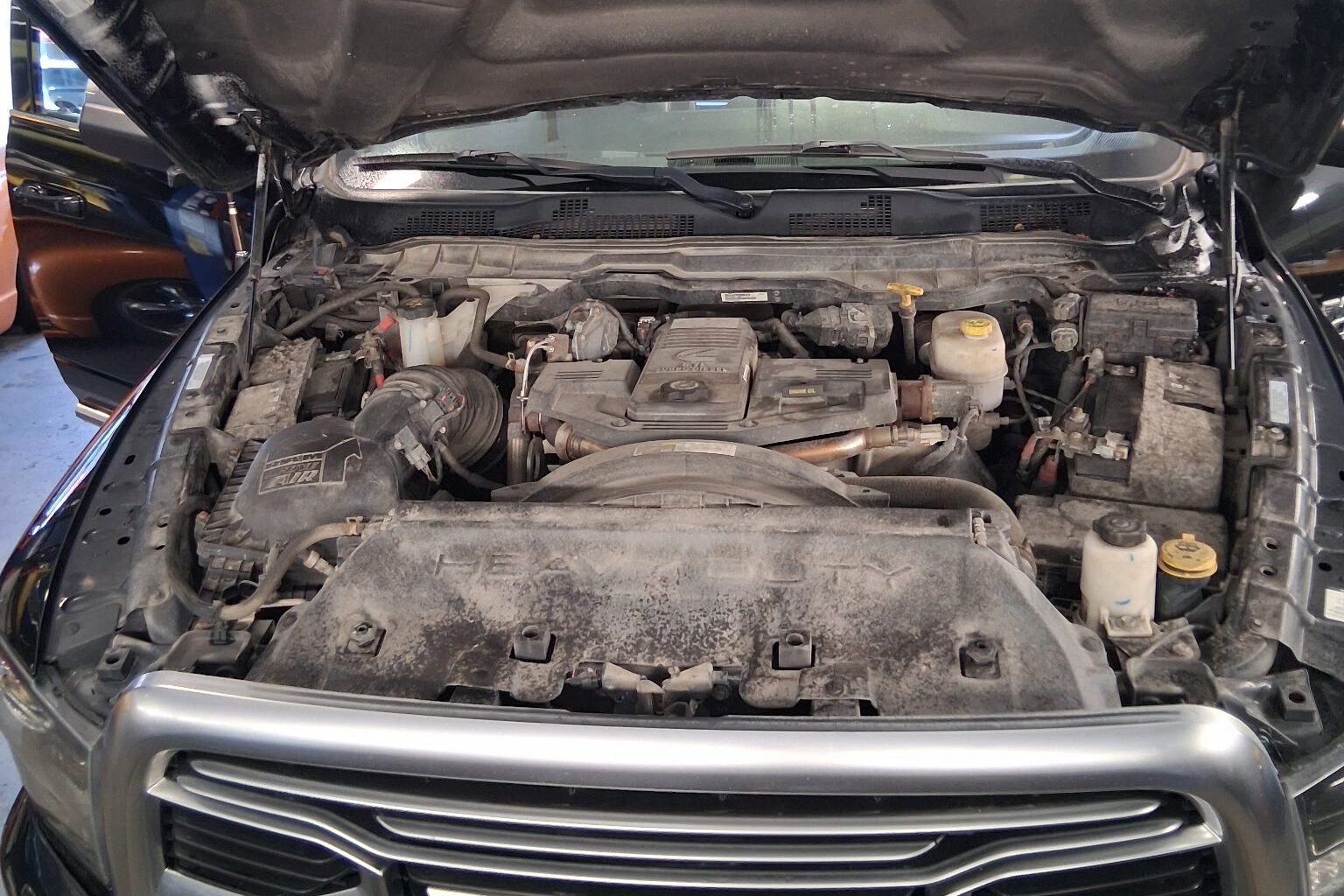
- Engine bay detail — $100 flat. Dust plus grease in a bay hides leaks, and a clean bay lets you spot one early.
- Odour removal — quoted on sight, for when the dust has been damp long enough to go stale.
One thing we won't pitch you: we don't polish, buff or correct the scratch haze out of your dash or your paint. That's correction work and it isn't our lane. We'll get the truck genuinely clean and be straight with you about what cleaning can't undo.
Four Things to Do Before You Book It In
- Empty it. Every tool, binder, coffee cup and half-bag of fasteners. An empty cab means we spend the hours on the dust instead of on moving your stuff around.
- Don't hose the interior first. Trying to soften concrete dust with water sets it. Leave it dry and leave it to us.
- Buy a cabin air filter now, fit it after. A fresh filter installed before the detail just eats the dust we're about to stir loose. Put the new one in on the way home.
- Tell us what kind of dust. Concrete, drywall and rock dust get handled differently. Two minutes on the phone changes how we set the truck up.
Book a drop-off at dirtydetails.ca/book, or call (604) 845-4060 and describe the worst of it. We've seen worse, and we'd rather have your truck than a clean one.
Interior, exterior or the full inside-and-out Complete Detail — book online in two minutes.